ServicesReverse Osmosis Systems
Reverse Osmosis Systems in Bastrop
Want water you actually enjoy drinking, straight from the kitchen? We install under-sink reverse osmosis systems that strip out what you can taste and much of what you can't. Before anything goes in, we test your water and check the plumbing under your sink.
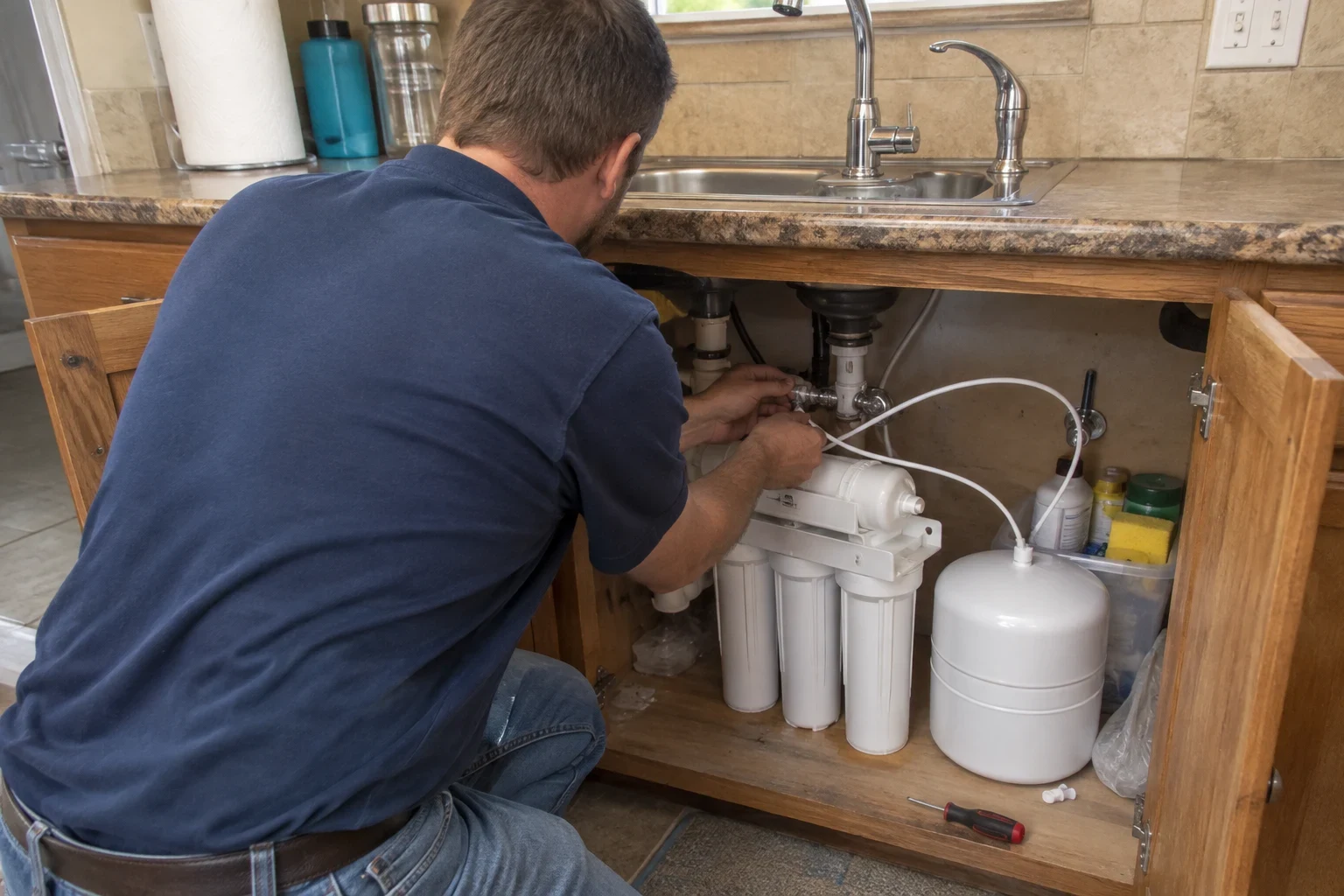
Clean drinking water from one dedicated faucet
Reverse osmosis sends your water through an extremely fine membrane that stops dissolved minerals, lead, many salts and other trace contaminants. Carbon stages on either side of the membrane remove the chlorine you can taste and smell. What you get flows from a small faucet next to your regular one, ready for drinking, coffee, ice and cooking.
An RO unit serves a single spot in your kitchen. Your glass of water, the pasta pot and the coffee maker get the filtered supply, while showers, laundry and toilets carry on with ordinary tap water. For a lot of families, that one faucet is exactly where better water matters most. If you'd like improved water throughout the house too, our whole-home filtration service can work alongside it.
Older houses are where we take our time. A cabinet that's been through several remodels, a shutoff nobody has touched in two decades or a drain patched together from odd parts can all change how an RO system should go in. Checking first means a clean install and no slow drip showing up under your sink a week later.
What comes with your reverse osmosis install
- Your water tested first
- We check your water before suggesting any system. The results show whether a standard RO unit will do the job or whether something like heavy sediment should be dealt with ahead of it.
- A close look under the sink
- We inspect the cold supply valve, the drain, the cabinet floor and any marks from past leaks. If a valve is corroded or stuck and should be replaced before we tie into it, you hear about it before we begin.
- Filters, membrane and tank
- Most systems have a sediment prefilter, a carbon prefilter, the RO membrane, a storage tank and a final carbon filter. We position everything so the housings are simple to reach at filter-change time.
- A faucet of its own
- Where we can, the drinking faucet goes into an unused sink hole or the old sprayer opening. We only drill a new hole if you say yes.
- Fridge or ice maker hookup if you want it
- We can carry RO water to your refrigerator as well. Before running tubing, we plan a path that avoids tight bends behind cabinets and stays clear of anything hot.
- Free installation
- Installation is free on the systems we put in. We tidy the cabinet and your kitchen before heading out.
Signs reverse osmosis is a good fit for your home
Bottled water is always on your shopping list
If you're hauling cases home every week, an RO faucet can take their place. Coffee and ice are usually where people notice the change first.
Your tap water tastes like a pool
Chlorine keeps city water safe, but lots of people can't stand the taste or smell. An RO system's carbon stages remove most of it.
Your house has older pipes
Original galvanized lines, older brass fittings or solder from before today's lead limits can release metals into water that sits in the pipes. RO is one of the most effective ways to cut lead at your drinking tap.
Cloudy spots on glasses and kettles
White film on glassware usually means dissolved minerals. RO water leaves much less behind, which is good news for coffee makers and humidifiers too.
You'd like extra assurance about trace contaminants
Your water may meet every standard and you'd still like another layer of protection for your family. That's a fair reason, and a water test shows you what's actually in it.
How the install day goes
- 1
Test the water and check under the sink
We test your water and measure your pressure, because most RO systems perform best above roughly 40 psi. If yours runs lower, a small booster pump may help, and we'll explain the reason.
- 2
Go over the plan with you
We explain the system, where each piece will sit and anything in your current plumbing that needs attention. You'll know the full price before a single fitting comes out of the box.
- 3
Install and connect
We turn off the cold supply, add a feed valve, attach the drain saddle, mount the unit and set the faucet. A typical install takes a couple of hours, and your main kitchen faucet stays usable throughout.
- 4
Flush, leak-check and a quick walkthrough
We flush the new filters, let the tank fill and check each connection for leaks. Then we show you where the filters are and about when each one will need changing.
What moves the price of a reverse osmosis system
Because installation is free, your price comes down mainly to the equipment and whatever your plumbing needs to take it safely. You hear the whole picture from us before any work starts. Under an older kitchen sink, the condition of the valves and drain is usually the biggest unknown, so we check there first.
- Which system you choose
- Our 5-stage tank reverse osmosis system (sediment, GAC, carbon block, RO membrane and post carbon, with an under-sink storage tank) is the lower-price option, our tankless reverse osmosis system (800 gallons per day, 7 stages) costs more, and a Pure Alkaline Filter that remineralizes the water can be added to either. Tankless units also need a power outlet inside the cabinet.
- Your water pressure
- Low pressure makes the membrane work harder and send more water to the drain. A small booster pump fixes that, and it adds to the cost when it's needed.
- What's already under the sink
- An old shutoff that won't turn, a dated drain fitting or a soft, water-stained cabinet floor may need fixing before we connect anything. We show you what we found and you decide.
- Lines to the fridge or ice maker
- Sending filtered water to your refrigerator takes extra tubing and fittings. The farther the run, the more material it uses.
- Filter upkeep over time
- Prefilters typically get swapped every 6 to 12 months, and the membrane lasts a few years depending on your water. We lay out that schedule up front so the running cost is clear from day one.
Common questions about reverse osmosis
Something not covered here? (512) 852-4359
Does reverse osmosis remove lead?
A well-kept RO system is very effective at reducing lead at the faucet it feeds. That's most useful in older houses, where lead tends to come from old fittings or solder inside the home rather than from the supply. Keep in mind it only treats the water at that one faucet.
Does reverse osmosis waste water?
It does use a little. As the membrane holds back minerals and contaminants, it rinses them away through a small drain line, and that rinse takes water. Systems sold today are far more efficient than the units from years back, and good pressure or a booster pump trims the amount further.
Will the RO faucet be slow?
With a storage tank, a glass fills at an easy, normal pace. A big stockpot takes longer than at your main faucet, so most people keep using regular tap water for dishes and rinsing.
My sink cabinet is already packed. Will a system fit?
In most cases, yes. Compact and tankless models take up less space, and a tank can sometimes go in the cabinet next door. We measure and give you a straight answer about what will work.
Do I also need whole-home filtration?
Not always. If drinking and cooking water is your main concern, RO by itself may cover it. If chlorine bothers you in the shower or you notice grit at every tap, we can talk through whole-home filtration too.
Start with a look at your water
We'll test your water, check what's under your sink and tell you plainly whether reverse osmosis is the right fit. If it is, installation is free.